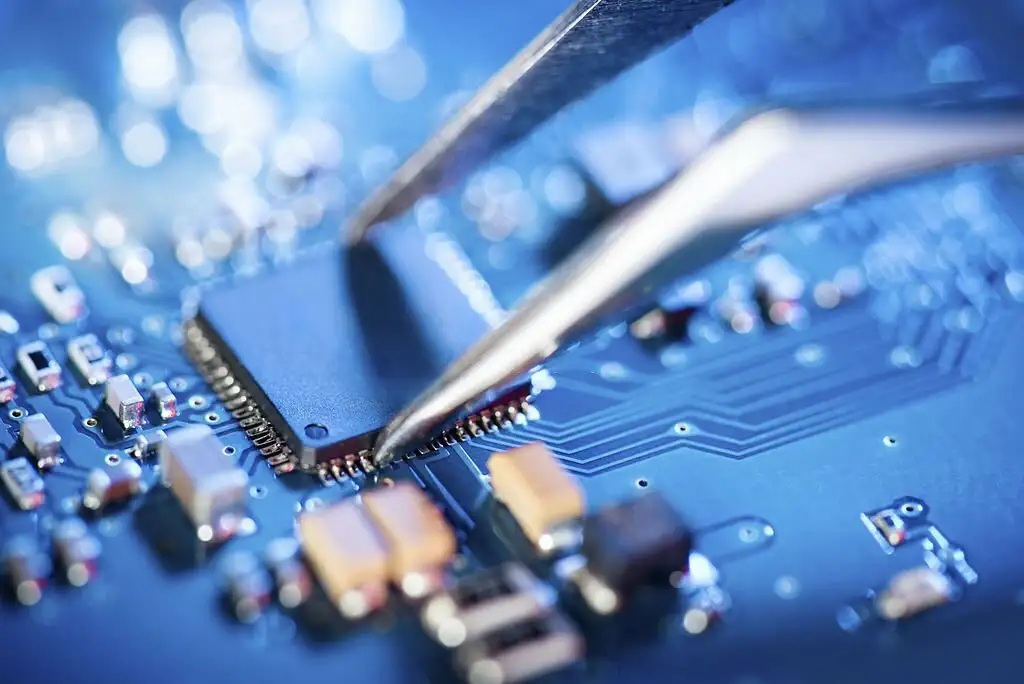
Microelectronics circuits are electronic circuits that are designed to operate on a very small scale, typically involving integrated circuits (ICs) and components with features at or below the micrometer level. These circuits are crucial in modern electronics, enabling the creation of compact, high-performance devices. Here are some key aspects of microelectronics circuits:
- Integration: Microelectronics circuits often involve the integration of a large number of electronic components onto a single semiconductor chip. This integration leads to smaller form factors, reduced power consumption, and improved performance.
- Silicon Chip Technology: Silicon is the most commonly used semiconductor material in microelectronics due to its excellent electrical properties. The process of creating integrated circuits on silicon wafers involves photolithography, doping, etching, and other semiconductor manufacturing techniques.
- Transistors: Transistors are the fundamental building blocks of microelectronics circuits. The most common transistors used in microelectronics are Metal-Oxide-Semiconductor Field-Effect Transistors (MOSFETs), which are used to create digital logic gates and analog amplifiers.
- Digital and Analog Circuits: Microelectronics circuits encompass both digital and analog circuits. Digital circuits are used for processing binary information, while analog circuits deal with continuous voltage levels. Many devices have a combination of both types of circuits.
- ICs (Integrated Circuits): ICs are complete circuits that are manufactured as a single unit. They can contain millions or even billions of transistors. Examples include microcontrollers, microprocessors, memory chips, and specialized ICs for various applications.
- Mixed-Signal Circuits: Some microelectronics circuits are “mixed-signal,” which means they include both analog and digital components. These are common in applications such as data converters (analog-to-digital and digital-to-analog converters) and communication devices.
- Packaging: The physical packaging of microelectronics circuits is essential to protect the circuitry and provide electrical connections. Packaging can range from simple dual in-line packages (DIPs) to advanced surface-mount technology (SMT) packages.
- Power Management: Efficient power management is crucial in microelectronics, as many devices are battery-powered. Power management circuits are used to regulate and optimize power consumption.
- RF and Microwave Circuits: Microelectronics also encompasses circuits designed for radio frequency (RF) and microwave applications, such as those used in wireless communication devices, radar systems, and satellite communication.
- Sensors and MEMS: Microelectronics circuits are used in sensors and Micro-Electro-Mechanical Systems (MEMS). MEMS devices integrate mechanical elements with microelectronics on a single chip, enabling applications like accelerometers and gyroscopes.
- Signal Processing: Many microelectronics circuits are dedicated to signal processing, including filters, amplifiers, and digital signal processors (DSPs). These are crucial in various applications, including audio, image processing, and communication systems.
- Nanoelectronics: The field of microelectronics is constantly evolving, and as technology advances, it’s moving toward nanoelectronics, where features are measured at the nanometer scale. This includes technologies like FinFET transistors and quantum-dot-based devices.
- System-on-Chip (SoC): An SoC is a type of IC that integrates not only the main processing unit but also various other components like memory, I/O interfaces, and peripherals. SoCs are commonly used in mobile devices and embedded systems.
Microelectronics circuits are at the heart of modern technology, playing a critical role in everything from smartphones and computers to medical devices and automotive systems. Their miniaturization, integration, and performance improvements continue to drive innovation in the electronics industry.