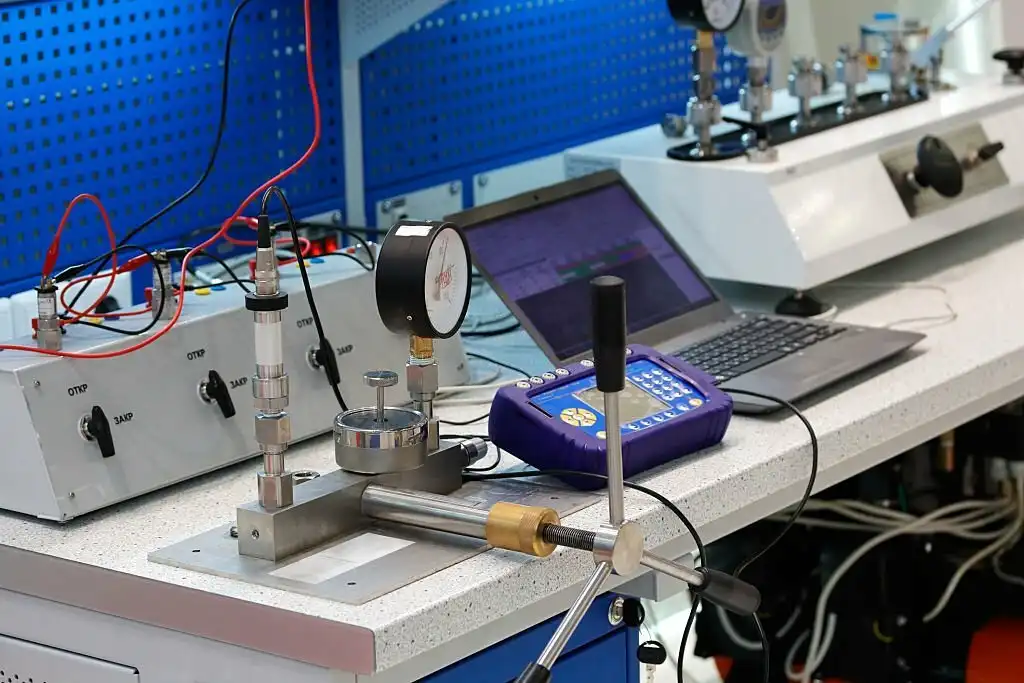
Analytical instrumentation refers to a class of instruments used to analyze and characterize the composition of substances. These instruments play a crucial role in various scientific and industrial applications, providing valuable information about the properties of materials. Here are some key aspects and types of analytical instrumentation:
Key Aspects:
- Analysis Techniques:
- Spectroscopy: Examples include UV-Visible spectroscopy, infrared spectroscopy, and nuclear magnetic resonance (NMR).
- Chromatography: Separation technique that involves the distribution of components between a stationary phase and a mobile phase. Examples include gas chromatography (GC) and liquid chromatography (LC).
- Mass Spectrometry: Identifies and quantifies the mass of atoms or molecules in a sample, providing information about their chemical structure.
- Electrochemistry: Studies the relationship between electricity and chemical reactions, often used in techniques like potentiometry and voltammetry.
- Detection Methods:
- Photometric Detection: Measures the intensity of light absorbed or emitted by a sample.
- Fluorescence Detection: Measures the fluorescence emitted by a substance when exposed to specific wavelengths of light.
- Mass Detection: Measures the mass of ions in mass spectrometry.
- Conductivity Detection: Measures the electrical conductivity of a solution.
- Automation and Integration:
- Many analytical instruments are now automated and integrated into larger systems, allowing for high-throughput analysis and improved precision.
- Data Analysis:
- Advanced analytical instruments generate large amounts of data. Data analysis techniques, including statistical methods and machine learning, are often employed to extract meaningful information.
Types of Analytical Instruments:
- Spectrophotometers:
- Used in UV-Visible, infrared, and fluorescence spectroscopy.
- Chromatographs:
- Separate and analyze complex mixtures.
- Mass Spectrometers:
- Identify and quantify the chemical composition of a sample based on the mass-to-charge ratio of ions.
- Nuclear Magnetic Resonance (NMR) Spectrometers:
- Provide information about the molecular structure and dynamics of compounds.
- Electrochemical Analyzers:
- Measure electrical properties of solutions, often used for studying redox reactions.
- X-ray Diffraction (XRD) Instruments:
- Analyze the crystal structure of materials.
- Atomic Absorption (AA) and Atomic Emission (AE) Spectrometers:
- Measure the concentration of elements in a sample by analyzing the absorption or emission of light.
- Infrared (IR) and Raman Spectrometers:
- Identify and characterize compounds based on their vibrational modes.
- Particle Size Analyzers:
- Find the size distribution of particles in a sample.
- Titration Instruments:
- Measure the volume of a solution required to react with a given analyte.
These instruments find applications in various fields, including chemistry, biology, environmental science, pharmaceuticals, food analysis, and materials science. Advances in analytical instrumentation continue to drive progress in scientific research and industrial processes.